Part II — Deep Learning
Master Deep Learning fundamentals and learn how production-ready Deep Learning systems are designed, trained, optimized, evaluated, deployed, and operated in modern enterprise environments.

📖 Overview
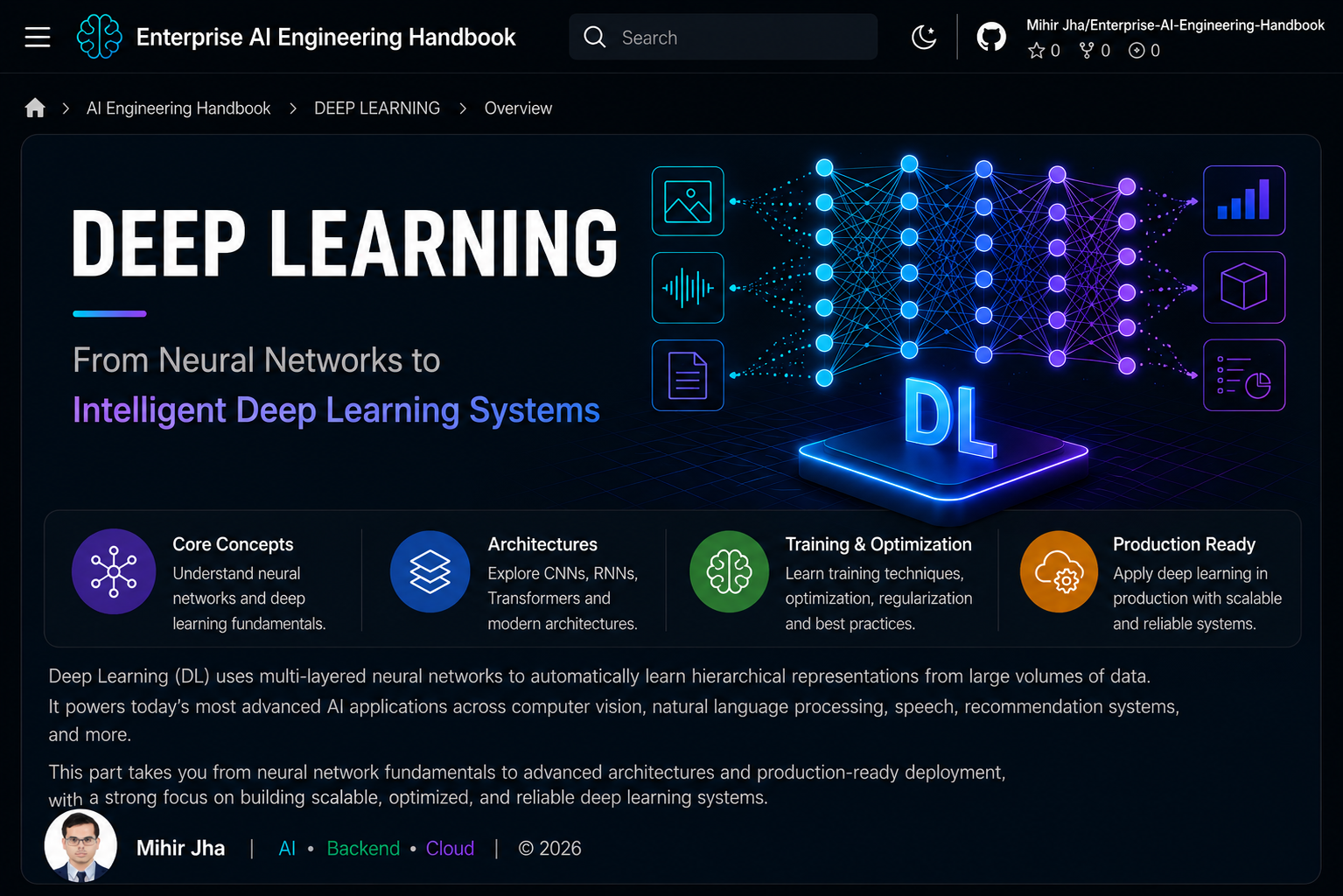
Deep Learning (DL) is a specialized branch of Machine Learning that enables computers to automatically learn hierarchical representations from structured and unstructured data using Artificial Neural Networks.
This module provides a production-focused learning journey through the complete Deep Learning lifecycle — from mathematical foundations and neural network fundamentals to modern architectures, generative models, reinforcement learning, framework engineering, GPU acceleration, and production deployment.
You'll learn how neural networks learn, how models are trained and optimized, how different architectures are selected for different data modalities, and how modern frameworks such as TensorFlow, Keras, and PyTorch are used to build real-world AI systems.
The module progresses from foundational concepts such as activation functions, probability, loss functions, Maximum Likelihood Estimation (MLE), forward propagation, and backpropagation to advanced architectures including CNNs, RNNs, LSTMs, Transformers, Vision Transformers, GANs, and Diffusion Models.
Designed for software engineers, backend developers, cloud engineers, solution architects, and AI engineers, this module bridges the gap between classical Machine Learning and modern AI Engineering, preparing you for advanced topics such as Foundation Models, Large Language Models (LLMs), and Generative AI.
🎯 Learning Outcomes
After completing this module, you will be able to:
🧠 Deep Learning Foundations
- Understand the core principles of Deep Learning
- Explain how Artificial Neural Networks learn from data
- Understand shallow and Deep Neural Networks
- Understand neurons, weights, biases, layers, and neural network architectures
- Understand forward propagation and backpropagation
📐 Mathematical & Statistical Foundations
- Understand linear and logistic regression from a Deep Learning perspective
- Understand probability and probability thresholding
- Apply sigmoid, tanh, ReLU, softmax, and other activation functions
- Understand Mean Squared Error (MSE) and Cross-Entropy Loss
- Understand Maximum Likelihood Estimation (MLE)
- Understand the relationship between likelihood, loss functions, and optimization
⚙️ Training & Optimization
- Understand Gradient Descent and Mini-Batch Gradient Descent
- Apply SGD, Momentum, RMSProp, Adam, and AdamW
- Understand learning-rate strategies and scheduling
- Apply Xavier and He weight initialization
- Understand vanishing and exploding gradients
- Apply L1, L2, Dropout, Early Stopping, and Batch Normalization
- Apply advanced optimization techniques to Deep Learning models
- Perform hyperparameter tuning and training optimization
🐍 TensorFlow & Keras
- Build Deep Learning models using TensorFlow and Keras
- Use the Keras Sequential API
- Use the Keras Functional API for complex architectures
- Build custom layers and custom models
- Implement custom training loops using GradientTape
- Build classification and regression models
- Apply callbacks and hyperparameter tuning using KerasTuner
- Train and optimize CNN and Transformer models using Keras
🔥 PyTorch
- Understand PyTorch tensors and tensor operations
- Understand Autograd and computational graphs
- Build models using
torch.nn.Module - Work with PyTorch Dataset and DataLoader
- Build efficient data pipelines
- Build regression and classification models
- Implement custom PyTorch training loops
- Use TorchVision and pretrained vision models
- Train Deep Learning models using GPU acceleration
👁️ Computer Vision
- Understand image preprocessing and augmentation
- Design Convolutional Neural Networks (CNNs)
- Understand convolution, feature maps, pooling, and feature extraction
- Optimize CNN architectures and training
- Apply Transfer Learning and fine-tuning
- Understand Residual Networks (ResNet)
- Use TorchVision pretrained models
- Understand Vision Transformers (ViT)
- Compare CNN, ViT, and CNN–ViT hybrid architectures
🔄 Sequential Learning & Transformers
- Understand Recurrent Neural Networks (RNNs)
- Understand LSTM and GRU architectures
- Understand sequence modeling and long-term dependencies
- Understand Attention Mechanisms and positional encoding
- Understand Query, Key, and Value representations
- Understand Multi-Head Attention
- Understand Transformer architecture
- Understand Encoder-only, Decoder-only, and Encoder–Decoder Transformers
- Understand major Transformer applications
🎨 Generative & Representation Learning
- Understand Autoencoders and representation learning
- Understand Generative Adversarial Networks (GANs)
- Understand Generator and Discriminator architectures
- Understand adversarial training
- Understand Diffusion Models
- Understand the role of Deep Learning in modern Generative AI
🎮 Reinforcement Learning
- Understand Reinforcement Learning fundamentals
- Understand agents, environments, states, actions, and rewards
- Understand Markov Decision Processes
- Understand Q-Learning and value-based learning
- Understand Deep Q Networks (DQN)
- Understand how neural networks are used for Deep Reinforcement Learning
🏭 Production Deep Learning
- Understand GPU-accelerated Deep Learning
- Design efficient training pipelines
- Understand Deep Learning training and model lifecycle management
- Evaluate and compare Deep Learning models
- Save and version trained models
- Understand model deployment and serving
- Monitor production Deep Learning systems
- Design production-ready Deep Learning architectures
🛣️ Recommended Learning Path
This module follows a progressive learning journey. Each phase builds upon concepts introduced in previous phases, moving from mathematical foundations and neural network fundamentals to modern Deep Learning architectures, generative models, reinforcement learning, and production-ready AI systems.
🧠 Phase 1 — Deep Learning Foundations
⚙️ Phase 2 — Training & Optimization
🐍 Phase 3 — TensorFlow, Keras & PyTorch
👁️ Phase 4 — Computer Vision & Vision Models
🔄 Phase 5 — Sequential Learning & Transformers
| Chapter | Status |
|---|---|
| 24. Recurrent Neural Networks (RNN) | ✅ |
| 25. LSTM & GRU | ✅ |
| 26. Attention Mechanism & Positional Encoding | ✅ |
| 27. Transformer Architecture | ✅ |
| 28. Transformer Applications | ✅ |
🎨 Phase 6 — Generative & Representation Learning
| Chapter | Status |
|---|---|
| 29. Autoencoders & Representation Learning | ✅ |
| 30. Generative Adversarial Networks (GANs) | ✅ |
| 31. Diffusion Models | ✅ |
🎮 Phase 7 — Reinforcement Learning
| Chapter | Status |
|---|---|
| 32. Reinforcement Learning Fundamentals | ✅ |
| 33. Markov Decision Processes & Q-Learning | ✅ |
| 34. Deep Reinforcement Learning & Deep Q Networks | ✅ |
🏭 Phase 8 — Production Deep Learning
| Chapter | Status |
|---|---|
| 35. GPU-Accelerated Deep Learning | ✅ |
| 36. Deep Learning Training & Model Lifecycle | ✅ |
| 37. Building Production Deep Learning Systems | ✅ |
🏢 Enterprise Perspective
Deep Learning powers many of today's most advanced AI systems across almost every industry.
Some common enterprise applications include:
- Computer Vision
- Medical Image Analysis
- Natural Language Processing (NLP)
- Speech Recognition
- Intelligent Document Processing
- Recommendation Systems
- Fraud Detection
- Predictive Maintenance
- Time-Series Forecasting
- Autonomous Systems
- Image Classification
- Object Detection
- Semantic Segmentation
- AI-Powered Search
- Generative AI
- Multimodal AI
- Reinforcement Learning
Throughout this module, you'll learn not only the underlying theory but also how Deep Learning systems are architected, trained, optimized, evaluated, deployed, monitored, and scaled in real-world enterprise environments using industry-standard frameworks such as TensorFlow, Keras, and PyTorch.
🧩 Practical Engineering Focus
This module emphasizes practical implementation alongside theory.
Where appropriate, the same Deep Learning concepts are demonstrated using both Keras and PyTorch, allowing direct comparison of:
- Model construction
- Data pipelines
- Training workflows
- Activation and loss functions
- Optimizers
- Evaluation
- GPU execution
- Model persistence
- Deployment considerations
Framework-specific capabilities covered throughout the module include:
- Keras Sequential API
- Keras Functional API
- Keras custom layers and models
- Custom Keras training loops
- TensorFlow GradientTape
- Keras callbacks and KerasTuner
- PyTorch tensors
- PyTorch Autograd
- PyTorch Dataset and DataLoader
- PyTorch
nn.Module - TorchVision
- GPU-accelerated training
🔬 Deep Learning Architecture Landscape
The module covers the evolution of Deep Learning architectures from basic neural networks to modern intelligent systems.
flowchart TD

ANN["🧠 Artificial Neural Networks"]
DNN["🔬 Deep Neural Networks"]

CNN["👁️ CNN"]
RNN["🔄 RNN"]

RESNET["🏗️ ResNet"]
LSTM["⏱️ LSTM / GRU"]

ATT["🎯 Attention"]
TRANS["🤖 Transformers"]

VIT["👁️ ViT"]
LLM["💬 LLMs"]

CV["🖼️ Computer Vision"]
FM["🌐 Foundation Models"]

GEN["✨ Modern Generative AI"]

ANN --> DNN

DNN --> CNN
DNN --> RNN

CNN --> RESNET
RNN --> LSTM

RESNET -.-> ATT
LSTM -.-> ATT

ATT --> TRANS

TRANS --> VIT
TRANS --> LLM

VIT --> CV
LLM --> FM

CV --> GEN
FM --> GEN