Part V — Advanced Retrieval-Augmented Generation
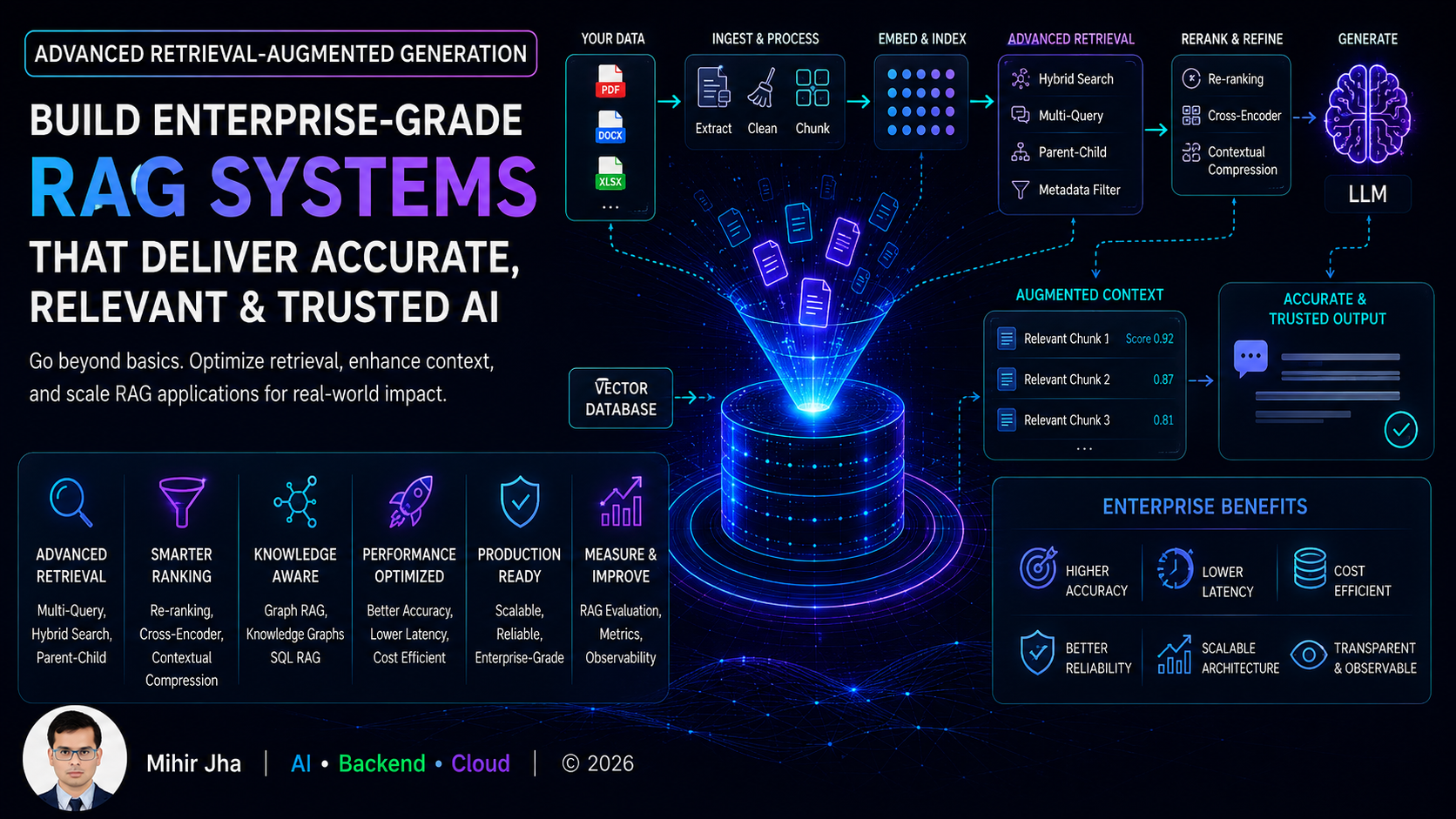
Master enterprise-grade Retrieval-Augmented Generation (RAG) by progressing from advanced retrieval techniques to scalable, observable, evaluated, and production-ready AI systems.
📖 Overview
Part IV introduced the foundations of Retrieval-Augmented Generation:
Enterprise RAG systems require much more than a basic vector search pipeline.
They need sophisticated retrieval strategies, multiple knowledge sources, ranking and filtering, context engineering, response validation, citations, evaluation, observability, performance optimization, and production architecture.
Part V takes RAG from:
The overall production pipeline becomes:
User Query
    ↓
Query Processing
    ↓
Advanced Retrieval
    ↓
Candidate Generation
    ↓
Re-ranking
    ↓
Context Selection
    ↓
Prompt Assembly
    ↓
LLM
    ↓
Response Validation
    ↓
Citation & Attribution
    ↓
Enterprise Response
    ↓
Evaluation
    ↓
Observability
    ↓
Performance & Cost Optimization
    ↓
Deployment
    ↓
Caching
    ↓
Multi-Tenancy
    ↓
Testing
    ↓
Failure Engineering
🧭 Advanced Retriever Capability Map
Advanced retrievers extend basic vector similarity search by solving specific retrieval problems.
| Retrieval Problem | Advanced Technique |
|---|---|
| Need semantic understanding | Vector Retriever |
| Need exact terminology | BM25 / Keyword Retrieval |
| Need both semantic + keyword matching | Hybrid / Ensemble Retrieval |
| Need diverse results | MMR |
| Query wording is ambiguous | Multi-Query Retrieval |
| Query requires metadata constraints | Self-Query Retrieval |
| Small chunks lose context | Parent Document Retrieval |
| Long documents require hierarchical context | Auto-Merging Retrieval |
| Information is connected through references | Recursive Retrieval |
| Multiple retrieval strategies are needed | Query Fusion |
| Results contain too much irrelevant context | Contextual Compression |
| Initial retrieval ranking is weak | Re-ranking |
Core Mental Model
Retrieval Problem
       ↓
Choose Retrieval Strategy
       ↓
Retrieve Candidates
       ↓
Fuse / Filter / Re-rank
       ↓
Select Context
       ↓
LLM
🎯 Learning Outcomes
After completing this module, you will be able to:
- Design advanced Retrieval-Augmented Generation architectures
- Implement and compare different retriever strategies
- Understand Core and Enterprise Retrieval patterns
- Implement Multi-Query and Self-Query Retrieval
- Implement Parent-Document Retrieval
- Apply Contextual Compression
- Implement Ensemble and Multi-Vector Retrieval
- Apply Time-Weighted Retrieval
- Build Hybrid Search systems
- Apply HyDE-based retrieval
- Design Router and Multi-Stage Retrieval
- Implement Agentic Retrieval
- Apply Re-ranking techniques
- Understand MMR and diversity-aware retrieval
- Build metadata-aware retrieval pipelines
- Apply advanced query rewriting
- Understand LlamaIndex retrieval architectures
- Understand FAISS and vector indexes
- Understand HNSW-based vector search
- Compare vector search technologies
- Build Graph RAG systems
- Understand Knowledge Graphs for RAG
- Build SQL RAG systems
- Design Multimodal RAG systems
- Understand Agentic RAG
- Design production prompt assembly pipelines
- Engineer effective context selection
- Validate generated responses
- Implement citation and source attribution
- Design enterprise response contracts
- Evaluate and benchmark RAG systems
- Implement RAG observability
- Optimize RAG performance
- Optimize RAG costs
- Design production retrieval architectures
- Build complete production-grade RAG systems
- Design RAG deployment patterns
- Implement RAG caching strategies
- Design secure multi-tenant RAG systems
- Build RAG testing frameworks
- Diagnose and engineer for common RAG failure patterns
🧭 Learning Journey
flowchart LR
    A["Core Retrieval"] --> B["Enterprise Retrieval"]
    B --> C["LlamaIndex Retrieval"]
    C --> D["Vector Search"]
    D --> E["Advanced RAG"]
    E --> F["Production RAG"]
The progression is:
Core Retrieval
      ↓
Enterprise Retrieval
      ↓
Framework-Based Retrieval
      ↓
Vector Search Engineering
      ↓
Advanced RAG Architectures
      ↓
Production RAG Engineering
📚 01 — Core Retrieval Engineering
This section introduces the fundamental retriever architectures used in advanced RAG systems.
| Chapter | Status |
|---|---|
| 01. VectorStore Retriever | ✅ |
| 02. Multi-Query Retriever | ✅ |
| 03. Self-Query Retriever | ✅ |
| 04. Parent-Document Retriever | ✅ |
| 05. Retriever Comparison | ✅ |
Retrieval progression
VectorStore Retriever
        ↓
Multi-Query Retriever
        ↓
Self-Query Retriever
        ↓
Parent-Document Retriever
        ↓
Retriever Selection
🔎 02 — Enterprise Retrieval Engineering
This section introduces advanced retrieval strategies for improving relevance, diversity, contextual quality, and retrieval flexibility.
Enterprise retrieval architecture
flowchart TD
    A["User Query"] --> B["Query Processing"]

    B --> C["Initial Retrieval"]

    C --> D["Vector Search"]
    C --> E["Keyword Search"]
    C --> F["Hybrid Search"]

    D --> G["Candidate Set"]
    E --> G
    F --> G

    G --> H["Filtering"]
    H --> I["Contextual Compression"]
    I --> J["Re-ranking"]
J --> K["Final Retrieval Context"]Re-ranking
Re-ranking separates:
from:
🧩 03 — LlamaIndex Retrieval Engineering
LlamaIndex is used here to demonstrate retrieval concepts and advanced retrieval implementations.
The focus remains on retrieval engineering rather than becoming a generic framework tutorial.
Framework implementation model
Retrieval Concept
       ↓
Framework-Agnostic Design
       ↓
LlamaIndex Implementation
       ↓
Production Retrieval Pattern
General framework architecture and framework comparisons remain in Part VIII — AI Engineering Frameworks & Tooling.
🗄️ 04 — Vector Search Engineering
This section focuses on the underlying vector-search infrastructure used by RAG systems.
| Chapter | Status |
|---|---|
| 01. FAISS Fundamentals | ✅ |
| 02. FAISS Indexes | ✅ |
| 03. HNSW and Index Selection | ✅ |
| 04. FAISS vs ChromaDB vs Milvus | ✅ |
Vector search architecture
flowchart LR
    A["Document"] --> B["Embedding"]
    B --> C["Vector"]
    C --> D["Vector Index"]

    E["Query"] --> F["Query Embedding"]
    F --> D

    D --> G["Nearest Neighbors"]
    G --> H["Retrieved Documents"]
🧠 05 — Advanced RAG Architecture
This section expands RAG beyond conventional vector retrieval.
| Topic | Status |
|---|---|
| 01. Advanced RAG Architecture | ✅ |
| 02. Graph RAG | ✅ |
| 03. Knowledge Graphs for RAG | ✅ |
| 04. SQL RAG | ✅ |
| 05. Multimodal RAG | ✅ |
| 06. Agentic RAG | ✅ |
Graph RAG
flowchart TD
    A["Documents"] --> B["Entity Extraction"]
    B --> C["Relationships"]
    C --> D["Knowledge Graph"]

    E["User Query"] --> F["Graph Retrieval"]
    F --> D

    D --> G["Relevant Subgraph"]
    G --> H["Context"]
    H --> I["LLM"]
    I --> J["Response"]
SQL RAG
Natural Language
      ↓
Query Understanding
      ↓
SQL Generation
      ↓
SQL Validation
      ↓
Enterprise Database
      ↓
Structured Results
      ↓
LLM
      ↓
Response
Multimodal RAG
Text
Images
Tables
Charts
PDFs
      ↓
Multimodal Processing
      ↓
Multimodal Retrieval
      ↓
Context
      ↓
Multimodal Model
      ↓
Response
Agentic RAG
flowchart TD
    A["User Query"] --> B["Retrieval Planner"]
    B --> C["Select Retrieval Strategy"]
    C --> D["Retrieve"]
    D --> E["Evaluate Results"]

    E -->|Insufficient| B
    E -->|Sufficient| F["Context"]
    F --> G["LLM"]
Agentic RAG focuses on intelligent retrieval decisions. General AI Agent architecture is covered in Part VI.
🏭 06 — Production RAG Engineering
This section brings advanced retrieval into a complete production pipeline, covering deployment, caching, multi-tenancy, testing, and failure engineering.
Production RAG flow
flowchart TD
    A["User Query"] --> B["Query Processing"]
    B --> C["Advanced Retrieval"]
    C --> D["Candidate Generation"]
    D --> E["Re-ranking"]
    E --> F["Context Selection"]
    F --> G["Prompt Assembly"]
    G --> H["LLM"]
    H --> I["Response Validation"]
    I --> J["Citation"]
    J --> K["Enterprise Response"]

    K --> L["Evaluation"]
    K --> M["Observability"]

    L --> N["Optimization"]
    M --> N

    N --> O["Deployment"]
    O --> P["Caching"]
    P --> Q["Multi-Tenancy"]
    Q --> R["Testing"]
    R --> S["Failure Engineering"]
Prompt Assembly
System Instructions
        +
User Query
        +
Retrieved Context
        +
Conversation History
        +
Metadata
        +
Response Requirements
        ↓
Prompt Assembly
        ↓
LLM
Response Validation
flowchart LR
    A["LLM Response"] --> B["Schema Validation"]
    B --> C["Grounding Check"]
    C --> D["Citation Check"]
    D --> E["Policy / Safety Check"]
    E --> F["Enterprise Response"]
Citation & Source Attribution
Enterprise Response
A production RAG API should return an application-level response rather than raw model text.
RAG Evaluation
Example evaluation dimensions:
| Area | Examples |
|---|---|
| Retrieval | Precision@K, Recall@K, MRR, NDCG |
| Generation | Correctness, Relevance, Faithfulness |
| Context | Context Relevance, Context Recall |
| Attribution | Citation Accuracy |
| Operations | Latency, Cost, Reliability |
RAG Observability
flowchart TD
    A["Request"] --> B["Query"]
    B --> C["Retrieval"]
    C --> D["Re-ranking"]
    D --> E["Prompt Assembly"]
    E --> F["LLM"]
    F --> G["Validation"]
    G --> H["Response"]

    B --> I["Observability"]
    C --> I
    D --> I
    E --> I
    F --> I
    G --> I
    H --> I
Important telemetry includes:
Latency
Retrieval Scores
Retrieved Documents
Re-ranking Scores
Token Usage
Prompt Size
Model Usage
Errors
Trace IDs
Cost
Performance & Cost Optimization
Optimization areas include:
- Retrieval latency
- Vector index performance
- Re-ranking latency
- Parallel retrieval
- Caching
- Context reduction
- Model selection
- Token optimization
- Infrastructure optimization
- Batch processing
🚀 07 — RAG Deployment Patterns
Production RAG requires deliberate deployment architecture.
Key deployment considerations include:
Application Deployment
        ↓
RAG Service Deployment
        ↓
Retriever Deployment
        ↓
Vector Database Deployment
        ↓
LLM Integration
        ↓
Scaling
        ↓
Availability
        ↓
Disaster Recovery
Deployment patterns include:
- Monolithic RAG applications
- Modular RAG services
- Microservice-based RAG
- Serverless RAG
- Containerized RAG
- Kubernetes-based RAG
- Managed cloud RAG
- Hybrid RAG
- Multi-region RAG
- Active-active architectures
- Active-passive architectures
- Blue-green deployments
- Canary deployments
The focus is not merely:
"How do I deploy RAG?"
but:
"How do I deploy RAG reliably at enterprise scale?"
⚡ 08 — RAG Caching Strategies
Caching is a major production optimization mechanism.
A RAG platform can potentially cache:
However, caching introduces correctness and security concerns.
Important considerations:
Cache Key
Tenant
Authorization Scope
Document Version
Index Version
Model Version
Prompt Version
TTL
Invalidation
Caching must therefore be treated as:
🏢 09 — Multi-Tenant RAG
Enterprise RAG platforms frequently serve multiple organizations, departments, or customers.
The architecture must enforce:
Tenant Isolation
        ↓
Authorization
        ↓
Data Isolation
        ↓
Retrieval Isolation
        ↓
Cache Isolation
        ↓
Configuration Isolation
        ↓
Observability Isolation
A typical request path becomes:
User
 ↓
Identity
 ↓
Tenant Resolution
 ↓
Authorization
 ↓
Tenant-Aware Retrieval
 ↓
Tenant-Aware Context
 ↓
LLM
 ↓
Tenant-Aware Response
Critical concerns include:
- Tenant isolation
- Cross-tenant leakage
- Tenant-aware indexes
- Metadata filtering
- Tenant-aware cache keys
- Tenant quotas
- Noisy-neighbor protection
- Tenant-level observability
- Tenant-level cost attribution
- Data residency
- Tenant-specific configuration
🧪 10 — RAG Testing Frameworks
Production RAG requires more than traditional unit tests.
Testing should cover:
Unit Testing
      ↓
Integration Testing
      ↓
Retrieval Testing
      ↓
Evaluation Testing
      ↓
Security Testing
      ↓
Performance Testing
      ↓
Regression Testing
      ↓
Production Testing
Important test categories include:
- Retrieval tests
- Context tests
- Generation tests
- Citation tests
- Hallucination tests
- Prompt injection tests
- Authorization tests
- Multi-tenant isolation tests
- Performance tests
- Load tests
- Cost tests
- Regression tests
- Adversarial tests
- Failure injection tests
The objective is to make RAG behavior:
🚨 11 — RAG Failure Patterns
RAG systems can fail even when:
A production RAG failure can originate from:
Data
 ↓
Parsing
 ↓
Chunking
 ↓
Embedding
 ↓
Indexing
 ↓
Query Understanding
 ↓
Retrieval
 ↓
Filtering
 ↓
Reranking
 ↓
Context
 ↓
Prompt
 ↓
LLM
 ↓
Validation
 ↓
Citation
 ↓
Cache
 ↓
Security
 ↓
Infrastructure
Common failure categories include:
- Missing documents
- Stale documents
- Parsing failures
- OCR failures
- Chunking failures
- Embedding mismatch
- Indexing failures
- Query rewriting failures
- Retrieval failures
- Reranking failures
- Context overload
- Context truncation
- Hallucination
- Citation errors
- Prompt injection
- Authorization failures
- Cross-tenant leakage
- Cache leakage
- Cache stampede
- Freshness failures
- Dependency failures
- Retry storms
- Agent loops
- Cost explosions
- Latency failures
- Configuration drift
- Deployment regressions
- Disaster recovery failures
The engineering objective becomes:
🏗️ Production RAG Capability Map
flowchart TD

    A["Production RAG"] --> B["Reliability"]
    A --> C["Security"]
    A --> D["Performance"]
    A --> E["Cost"]
    A --> F["Scalability"]
    A --> G["Evaluation"]
    A --> H["Operations"]

    B --> B1["Validation"]
    B --> B2["Failure Handling"]
    B --> B3["Fallback"]
    B --> B4["Recovery"]

    C --> C1["Authorization"]
    C --> C2["Tenant Isolation"]
    C --> C3["Prompt Injection Defense"]
    C --> C4["Data Protection"]

    D --> D1["Caching"]
    D --> D2["Parallel Retrieval"]
    D --> D3["Index Optimization"]
    D --> D4["Context Optimization"]

    E --> E1["Token Optimization"]
    E --> E2["Model Selection"]
    E --> E3["Caching"]
    E --> E4["Resource Optimization"]

    F --> F1["Horizontal Scaling"]
    F --> F2["Multi-Tenant"]
    F --> F3["Multi-Region"]
    F --> F4["Load Management"]

    G --> G1["Retrieval Evaluation"]
    G --> G2["Answer Evaluation"]
    G --> G3["Regression"]
    G --> G4["Production Feedback"]

    H --> H1["Observability"]
    H --> H2["Deployment"]
    H --> H3["Testing"]
    H --> H4["Incident Response"]
🏢 Enterprise RAG Maturity Model
Level 1 — Prototype
Characteristics:
- Basic vector retrieval
- Minimal evaluation
- No sophisticated observability
- Limited security controls
Level 2 — Structured RAG
Characteristics:
- Better document processing
- Metadata
- Basic evaluation
- Structured retrieval
Level 3 — Advanced RAG
Characteristics:
- Better retrieval quality
- Better context selection
- Retrieval benchmarking
- Performance optimization
Level 4 — Production RAG
Characteristics:
- Production deployment
- Monitoring
- Resilience
- Cost optimization
- Multi-tenant support
Level 5 — Enterprise RAG Platform
Multi-Tenant
+
Multi-Region
+
Governance
+
Security
+
Evaluation
+
FinOps
+
Reliability
+
Platform Engineering
Characteristics:
- Enterprise-scale RAG
- Tenant isolation
- Centralized platform capabilities
- Automated evaluation
- Advanced observability
- Disaster recovery
- Governance
- Continuous improvement
🧠 Production RAG Mental Model
                PRODUCTION RAG

                     User
                      │
                      ▼
                 API Gateway
                      │
                      ▼
               Identity / Auth
                      │
                      ▼
                Query Engine
                      │
                      ▼
             Retrieval Orchestrator
                      │
          ┌───────────┼───────────┐
          ▼           ▼           ▼
       Vector       Hybrid       SQL
          │           │           │
          └───────────┼───────────┘
                      ▼
                   Reranker
                      │
                      ▼
               Context Engine
                      │
                      ▼
                Prompt Assembly
                      │
                      ▼
                     LLM
                      │
                      ▼
               Response Validator
                      │
                      ▼
                   Citation
                      │
                      ▼
              Enterprise Response
                      │
          ┌───────────┼───────────┐
          ▼           ▼           ▼
       Cache       Metrics      Traces
          │           │           │
          └───────────┼───────────┘
                      ▼
                Observability
                      │
                      ▼
              Continuous Evaluation
🔐 Production RAG Security Boundary
Security must surround the entire retrieval pipeline.
Authentication
      ↓
Authorization
      ↓
Tenant Resolution
      ↓
Metadata Filtering
      ↓
Retrieval
      ↓
Context Authorization
      ↓
LLM
      ↓
Response Validation
      ↓
Citation Authorization
Never rely solely on:
for:
📊 Production RAG Metrics
A mature production system should monitor multiple dimensions.
Retrieval
Generation
System
Operations
Cost
Security
Authorization Failures
Prompt Injection Attempts
PII Events
Cross-Tenant Violations
Security Incidents
🔄 Continuous Improvement Loop
flowchart LR

    A["Production Traffic"]
    B["Observability"]
    C["Failure Detection"]
    D["Evaluation Dataset"]
    E["Regression Tests"]
    F["Architecture Improvement"]
    G["Safe Deployment"]

    A --> B
    B --> C
    C --> D
    D --> E
    E --> F
    F --> G
    G --> A
This creates a continuous engineering loop:
🏗️ Production RAG Engineering Principles
Principle 1 — Start Simple
Begin with:
and add complexity only when evaluation demonstrates a need.
Principle 2 — Retrieval Quality Comes First
A better LLM cannot compensate indefinitely for missing evidence.
Principle 3 — Security Is Independent
Authorization should not depend on:
Principle 4 — Every Optimization Has a Trade-Off
must be evaluated together.
Principle 5 — Measure Before Optimizing
Do not introduce:
without measuring the actual problem.
Principle 6 — Failure Is a Design Requirement
A production system must explicitly define:
What happens when retrieval fails?

What happens when the LLM fails?

What happens when the cache fails?

What happens when the index is stale?

What happens when authorization fails?

What happens when a tenant overloads the platform?
Principle 7 — Make Every Critical Component Observable
You should be able to answer:
What did we retrieve?

Why did we retrieve it?

What context reached the LLM?

Which model generated the response?

What citations were returned?

How long did it take?

How much did it cost?

Why did the system fail?
Principle 8 — Production RAG Is a Platform
At enterprise scale, RAG becomes:
Data Platform
+
Retrieval Platform
+
LLM Platform
+
Security Platform
+
Evaluation Platform
+
Observability Platform
rather than simply:
🧭 Relationship with Previous Sections
The overall RAG learning journey is:
Part IV
RAG Fundamentals
        ↓
Part V
Advanced Retrieval-Augmented Generation
        ↓
01 Core Retrieval Engineering
        ↓
02 Enterprise Retrieval Engineering
        ↓
03 LlamaIndex Retrieval Engineering
        ↓
04 Vector Search Engineering
        ↓
05 Advanced RAG Architecture
        ↓
06 Production RAG Engineering
The current module therefore represents the transition from:
to:
🔗 Complete Production RAG Path
01 Prompt Assembly
        ↓
02 Context Selection & Context Engineering
        ↓
03 Response Validation
        ↓
04 Citation & Source Attribution
        ↓
05 Enterprise Response
        ↓
06 RAG Evaluation & Benchmarking
        ↓
07 RAG Observability
        ↓
08 RAG Performance Optimization
        ↓
09 RAG Cost Optimization
        ↓
10 Production Retrieval Architecture
        ↓
11 Building Production RAG Systems
        ↓
12 RAG Deployment Patterns
        ↓
13 RAG Caching Strategies
        ↓
14 Multi-Tenant RAG
        ↓
15 RAG Testing Frameworks
        ↓
16 RAG Failure Patterns
📚 What This Module Completes
By the end of this section, the RAG journey has progressed from:
to:
to:
to:
to:
The progression is:
Retrieve
  ↓
Optimize
  ↓
Validate
  ↓
Evaluate
  ↓
Observe
  ↓
Optimize Performance
  ↓
Optimize Cost
  ↓
Deploy
  ↓
Cache
  ↓
Isolate Tenants
  ↓
Test
  ↓
Engineer for Failure
  ↓
Operate at Scale
🧭 Chapter Navigation
Previous Section:
04. Retrieval Augmented Generation
Current Section:
05. Advanced Retrieval Augmented generation
Next Section:
06. AI Agents
🚀 Start Learning
Begin with:
Then progress sequentially through:
The final destination is:
Designing RAG systems that are not only accurate, but secure, observable, scalable, cost-efficient, testable, deployable, and resilient in production.
Enterprise AI Engineering Handbook
Building Production-Grade Enterprise AI Systems — One Chapter at a Time.