Part VI — AI Agents
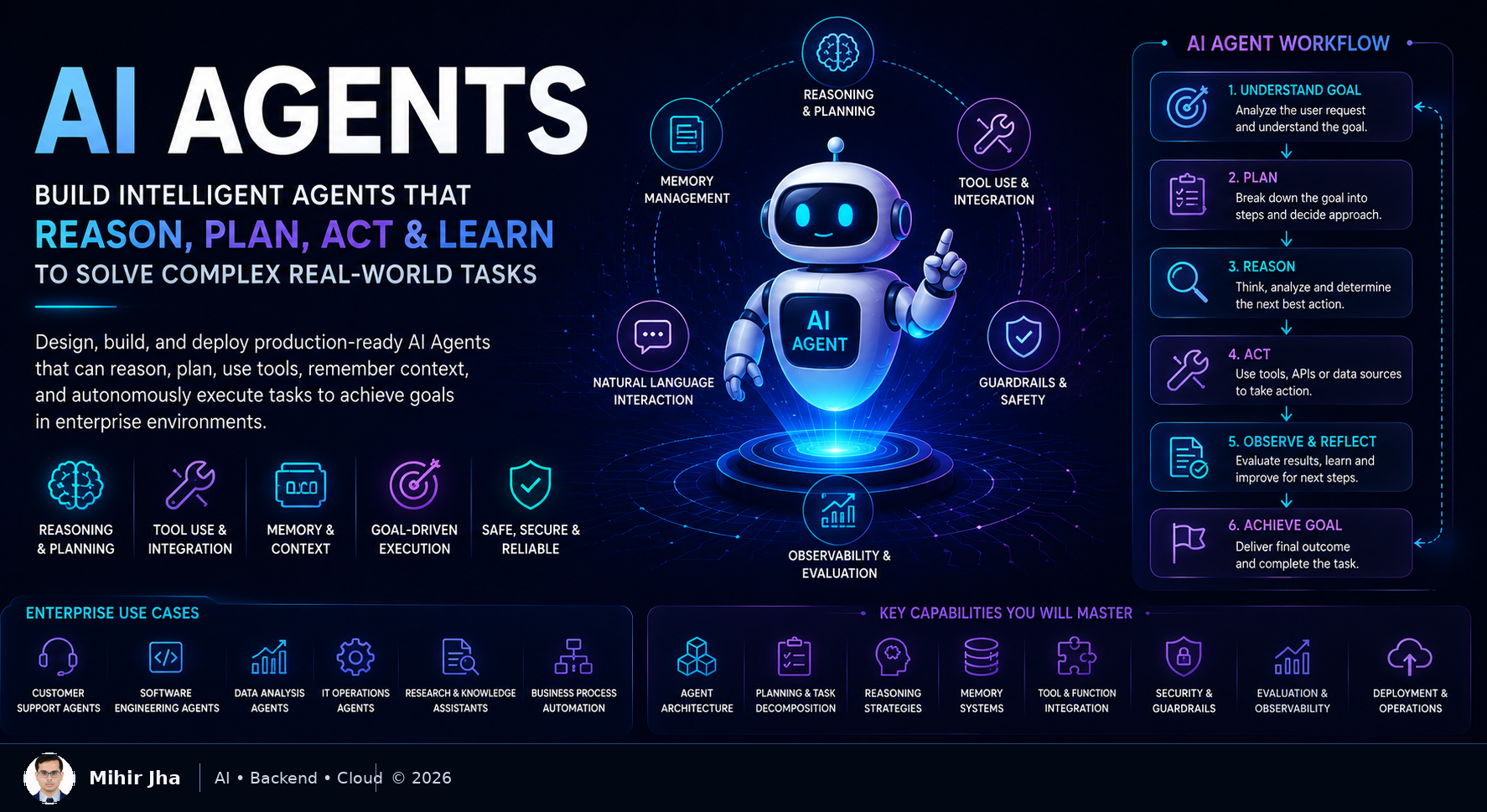
Learn how intelligent AI Agents are designed, built, deployed, and operated to solve complex tasks using reasoning, planning, memory, tool integration, communication, observability, and security in enterprise environments.

📖 Overview
AI Agents represent the next evolution of intelligent software systems.
Unlike traditional AI applications that primarily generate responses, AI Agents can:
Understand
   ↓
Reason
   ↓
Plan
   ↓
Use Tools
   ↓
Execute Actions
   ↓
Maintain State & Memory
   ↓
Observe Results
   ↓
Reflect
   ↓
Adapt
This module focuses on the engineering foundations required to build reliable AI Agent systems.
The learning journey progresses through:
AI Agent Fundamentals
        ↓
Planning & Reasoning
        ↓
Tool Calling & Tool Engineering
        ↓
Agent Memory
        ↓
Agent Communication
        ↓
Agent Evaluation
        ↓
Agent Observability
        ↓
Agent Security
        ↓
Agent Deployment
        ↓
Enterprise AI Agent Architecture
The module is designed for:
- Software Engineers
- Backend Engineers
- Cloud Engineers
- AI Engineers
- Solution Architects
- Cloud AI Architects
- Enterprise Architects
The objective is to bridge the gap between:
The concepts developed here provide the foundation for Part VII — Agentic AI & Multi-Agent Systems, where the focus expands to autonomous multi-agent systems, collaboration, supervision, long-running agents, Agentic RAG, enterprise agent platforms, and agent communication protocols.
🎯 Learning Outcomes
After completing this module, you will be able to:
- Understand the architecture of modern AI Agents
- Understand how AI Agents differ from traditional LLM applications
- Design AI Agent systems around tools, memory, communication, and execution
- Design agents capable of planning and task decomposition
- Understand reasoning strategies used by AI Agents
- Apply reflection and self-correction patterns
- Understand Tool Calling and Function Calling
- Build and orchestrate tools for AI Agents
- Understand manual and framework-assisted tool calling
- Apply agent design best practices
- Design enterprise AI Agent architectures
- Understand different types of agent memory
- Design short-term and long-term memory
- Understand working, episodic, and semantic memory
- Design memory storage and retrieval patterns
- Apply memory compression and optimization strategies
- Understand communication between AI Agents
- Implement message-passing patterns
- Understand shared-memory communication
- Design event-driven agent architectures
- Apply publish-subscribe patterns
- Coordinate agents and agent-driven workflows
- Understand agent negotiation and conflict resolution
- Evaluate agent task completion and behavior
- Understand agent evaluation metrics and methodologies
- Design observable AI Agent systems
- Implement agent logging and tracing
- Monitor agent execution and behavior
- Define meaningful agent metrics
- Debug complex agent workflows
- Monitor agent cost
- Implement agent alerting
- Design secure AI Agent systems
- Protect agents against prompt injection
- Secure agent tools
- Implement agent authentication and authorization
- Manage secrets securely
- Protect enterprise data and privacy
- Apply agent sandboxing and guardrails
- Manage agent risk
- Understand AI Agent runtime and deployment architectures
- Design scalable and resilient agent deployments
- Build production-ready AI Agents using enterprise best practices
🛣️ Recommended Learning Path
This module is organized into six engineering areas.
01 — AI Agent Fundamentals
             ↓
02 — Agent Memory
             ↓
03 — Agent Communication
             ↓
04 — Agent Observability
             ↓
05 — Agent Security
             ↓
06 — Agent Deployment
The recommended learning progression is:
Understand the Agent
        ↓
Plan & Reason
        ↓
Use Tools
        ↓
Maintain Memory
        ↓
Communicate
        ↓
Reflect & Correct
        ↓
Evaluate
        ↓
Observe
        ↓
Secure
        ↓
Deploy
        ↓
Operate
🤖 01 — AI Agent Fundamentals
This section establishes the foundation for understanding how AI Agents work and how they can be engineered as intelligent software systems.
Agent Fundamentals
The fundamental agent execution model can be represented as:
                ┌──────────────┐
                │     Goal     │
                └──────┬───────┘
                       ↓
                ┌──────────────┐
                │   Reason     │
                └──────┬───────┘
                       ↓
                ┌──────────────┐
                │    Plan      │
                └──────┬───────┘
                       ↓
                ┌──────────────┐
                │ Select Tool  │
                └──────┬───────┘
                       ↓
                ┌──────────────┐
                │ Execute Tool │
                └──────┬───────┘
                       ↓
                ┌──────────────┐
                │    Observe   │
                └──────┬───────┘
                       ↓
                ┌──────────────┐
                │ Reflect /    │
                │ Self-Correct │
                └──────┬───────┘
                       │
                       └───────────────┐
                                       ↓
                                  Next Step
Planning & Task Decomposition
Planning transforms a high-level goal into executable steps.
Planning establishes the bridge between:
Agent Reasoning
Reasoning enables the agent to determine:
What is the goal?
      ↓
What information is required?
      ↓
What actions are available?
      ↓
Which action should be performed?
      ↓
What should happen next?
The focus is on engineering reasoning behavior rather than exposing private chain-of-thought.
Reflection & Self-Correction
Reflection allows an agent to evaluate intermediate results and determine whether corrective action is required.
Plan
 ↓
Execute
 ↓
Observe
 ↓
Evaluate Result
 ↓
 ┌───────────────┐
 │               │
Correct       Incorrect
 │               │
 ↓               ↓
Continue      Re-plan
                 ↓
              Re-execute
This provides a foundation for more advanced autonomous behavior explored in Part VII.
🧠 02 — Agent Memory
AI Agents require mechanisms for maintaining information across steps and, depending on the use case, across sessions.
This section explores different memory models and production memory engineering patterns.
Agent Memory Architecture
                    AI Agent
                       │
          ┌────────────┼────────────┐
          ↓            ↓            ↓
    Working Memory  Short-Term   Long-Term
                       │            │
                       └─────┬──────┘
                             ↓
                       Memory Store
                             │
                             ↓
                      Memory Retrieval
                             │
                             ↓
                           Agent
Memory Types
The module covers:
These memory types address different requirements around:
- Current task state
- Conversation context
- Previous interactions
- Learned information
- Persistent knowledge
Production Memory Engineering
The later chapters focus on:
This moves memory from a conceptual feature into an engineering component of an AI Agent platform.
🔗 03 — Agent Communication
As AI systems become more sophisticated, agents may need to communicate with other agents and services.
This section introduces communication patterns that form the foundation for more advanced multi-agent systems.
Agent Communication Model
                 Agent A
                    │
                    │ Message
                    ▼
              Communication
                 Layer
                    │
        ┌───────────┼───────────┐
        ▼           ▼           ▼
    Agent B      Agent C      Service
        │           │           │
        └───────────┼───────────┘
                    ▼
                 Results
Communication Patterns
The section covers:
Message Passing
      ↓
Shared Memory
      ↓
Event-Driven Communication
      ↓
Publish / Subscribe
      ↓
Agent Coordination
      ↓
Agent Negotiation
      ↓
Conflict Resolution
These patterns provide the communication foundation for the more advanced Multi-Agent Systems covered in Part VII.
📊 04 — Agent Observability
Production AI Agents are dynamic systems.
Unlike conventional request-response applications, an agent may perform multiple reasoning steps, tool calls, retries, state transitions, and decisions before producing a final result.
This makes observability a core architectural capability.
Agent Observability Architecture
                    Agent Request
                         │
                         ▼
                  Agent Execution
                         │
        ┌────────────────┼────────────────┐
        ▼                ▼                ▼
      Logs            Traces           Metrics
        │                │                │
        └────────────────┼────────────────┘
                         ▼
                  Observability
                     Platform
                         │
        ┌────────────────┼────────────────┐
        ▼                ▼                ▼
     Monitoring       Debugging        Alerting
                         │
                         ▼
                    Evaluation
Agent Telemetry
Important observability dimensions include:
Agent Runs
    ↓
Reasoning Steps
    ↓
Tool Calls
    ↓
Tool Results
    ↓
State Changes
    ↓
Retries
    ↓
Latency
    ↓
Token Usage
    ↓
Cost
    ↓
Errors
The objective is to make agent behavior:
🔐 05 — Agent Security
AI Agents introduce a new security boundary because they can reason, access tools, retrieve information, maintain memory, and potentially execute actions.
This section focuses on securing agents throughout their lifecycle.
Agent Security Boundary
User
 ↓
Identity
 ↓
Authentication
 ↓
Authorization
 ↓
Agent
 ↓
Policy / Guardrails
 ↓
Tool Authorization
 ↓
Tool Execution
 ↓
Enterprise System
Security must therefore be applied across:
Security Topics
The section covers:
- Agent security architecture
- Prompt injection
- Tool security
- Authentication
- Authorization
- Secrets management
- Data privacy
- Sandboxing
- Guardrails
- Risk management
The objective is to build agents that are not only capable, but also:
🚀 06 — Agent Deployment
AI Agents must ultimately run as reliable production software.
This section focuses on the runtime and deployment engineering required to move agents from development environments into production.
| Chapter | Status |
|---|---|
| 01. Agent Deployment Overview | ✅ |
| 02. Agent Runtime & Execution | ✅ |
| 03. Agent Scaling & Resilience | ✅ |
| 04. Production Agent Deployment | ✅ |
Agent Deployment Architecture
                    Client
                      │
                      ▼
                API Gateway
                      │
                      ▼
                Agent Service
                      │
          ┌───────────┼───────────┐
          ▼           ▼           ▼
       Memory       Tools        LLM
       Service      Services     Gateway
          │           │           │
          └───────────┼───────────┘
                      ▼
                Agent Runtime
                      │
          ┌───────────┼───────────┐
          ▼           ▼           ▼
       Logging      Metrics      Tracing
Agent Runtime
The runtime is responsible for executing the agent loop:
Receive Task
     ↓
Load State
     ↓
Plan
     ↓
Reason
     ↓
Select Action
     ↓
Execute Tool
     ↓
Observe Result
     ↓
Update State
     ↓
Continue / Complete
Scaling & Resilience
Production agents must account for:
- Concurrent requests
- Long-running executions
- Tool latency
- LLM latency
- Retry behavior
- Timeouts
- Failure recovery
- Horizontal scaling
- Queue-based execution
- Backpressure
- Rate limiting
- Resource isolation
The goal is:
🏢 Enterprise AI Agent Architecture
The concepts across all six sections come together into an enterprise agent architecture.
                         User
                           │
                           ▼
                    API / Agent Gateway
                           │
                           ▼
                    Authentication
                           │
                           ▼
                    Authorization
                           │
                           ▼
                      AI Agent
                           │
          ┌────────────────┼────────────────┐
          ▼                ▼                ▼
       Planning          Memory           Tools
          │                │                │
          └────────────────┼────────────────┘
                           ▼
                  Agent Communication
                           │
                           ▼
                    Agent Execution
                           │
             ┌─────────────┼─────────────┐
             ▼             ▼             ▼
          Logging        Tracing       Metrics
             │             │             │
             └─────────────┼─────────────┘
                           ▼
                    Observability
                           │
                           ▼
                     Evaluation
                           │
                           ▼
                      Guardrails
                           │
                           ▼
                     Agent Runtime
                           │
                           ▼
                  Enterprise Systems
🧩 Part VI Capability Map
flowchart TD

    A["AI Agent"] --> B["Fundamentals"]
    A --> C["Memory"]
    A --> D["Communication"]
    A --> E["Observability"]
    A --> F["Security"]
    A --> G["Deployment"]

    B --> B1["Planning"]
    B --> B2["Reasoning"]
    B --> B3["Tool Calling"]
    B --> B4["Function Calling"]
    B --> B5["Reflection"]
    B --> B6["Self-Correction"]
    B --> B7["Agent Architecture"]

    C --> C1["Short-Term"]
    C --> C2["Long-Term"]
    C --> C3["Working"]
    C --> C4["Episodic"]
    C --> C5["Semantic"]
    C --> C6["Storage"]
    C --> C7["Retrieval"]
    C --> C8["Compression"]

    D --> D1["Message Passing"]
    D --> D2["Shared Memory"]
    D --> D3["Event Driven"]
    D --> D4["Publish / Subscribe"]
    D --> D5["Coordination"]
    D --> D6["Negotiation"]
    D --> D7["Conflict Resolution"]

    E --> E1["Logging"]
    E --> E2["Tracing"]
    E --> E3["Monitoring"]
    E --> E4["Metrics"]
    E --> E5["Debugging"]
    E --> E6["Evaluation"]
    E --> E7["Cost Monitoring"]
    E --> E8["Alerting"]

    F --> F1["Prompt Injection"]
    F --> F2["Tool Security"]
    F --> F3["Authentication"]
    F --> F4["Authorization"]
    F --> F5["Secrets"]
    F --> F6["Privacy"]
    F --> F7["Sandboxing"]
    F --> F8["Guardrails"]
    F --> F9["Risk Management"]

    G --> G1["Agent Runtime"]
    G --> G2["Execution"]
    G --> G3["Scaling"]
    G --> G4["Resilience"]
    G --> G5["Production Deployment"]
🔄 AI Agent Engineering Lifecycle
Design
  ↓
Build
  ↓
Plan
  ↓
Reason
  ↓
Integrate Tools
  ↓
Add Memory
  ↓
Communicate
  ↓
Reflect / Correct
  ↓
Evaluate
  ↓
Secure
  ↓
Observe
  ↓
Deploy
  ↓
Operate
  ↓
Improve
This lifecycle establishes the engineering mindset required for production AI Agents.
🧠 Relationship with RAG
Part V focuses primarily on knowledge retrieval and grounded generation.
Part VI introduces agents that can use those capabilities as part of a larger execution loop.
                  Part V
              Advanced RAG
                   │
                   ▼
             Retrieval / RAG
                   │
                   ▼
                AI Agent
                   │
        ┌──────────┼──────────┐
        ▼          ▼          ▼
      Tools      Memory     APIs
        │          │          │
        └──────────┼──────────┘
                   ▼
              Agent Action
More advanced Agentic RAG is intentionally explored in Part VII — Agentic AI & Multi-Agent Systems.
🚀 From AI Agents to Agentic AI
Part VI focuses on the engineering foundations of individual AI Agents.
The next progression is:
Part VI
AI Agents
      ↓
Part VII
Agentic AI
      ↓
Multi-Agent Systems
      ↓
Supervisor Patterns
      ↓
Hierarchical Agents
      ↓
Collaborative Agents
      ↓
Long-Running Agents
      ↓
Agentic RAG
      ↓
Enterprise Agent Platforms
      ↓
Agent Communication Protocols
Part VII will extend the concepts learned here into larger autonomous systems.
Protocols such as A2A and other agent communication protocols belong to Part VII and are intentionally excluded from Part VI.
📚 What This Module Establishes
By completing Part VI, you will have developed the foundations required to understand:
AI Agent Fundamentals
        ↓
Planning & Reasoning
        ↓
Tool Integration
        ↓
Agent Memory
        ↓
Agent Communication
        ↓
Reflection & Self-Correction
        ↓
Agent Evaluation
        ↓
Agent Observability
        ↓
Agent Security
        ↓
Agent Deployment
        ↓
Enterprise AI Agent Architecture
This provides the foundation for building more advanced:
Agentic AI
Multi-Agent Systems
Autonomous Workflows
Agentic RAG
Enterprise Agent Platforms
Agent Communication Protocols
🧭 Part VI Architecture
The complete learning architecture is:
                 PART VI — AI AGENTS

                         AI Agent
                            │
          ┌─────────────────┼─────────────────┐
          ▼                 ▼                 ▼
      Fundamentals        Memory        Communication
          │                 │                 │
          ▼                 ▼                 ▼
    Planning &          Memory Store    Agent Messaging
     Reasoning               │                 │
          │                  │                 │
          └──────────────────┼─────────────────┘
                             ▼
                       Agent Runtime
                             │
                    ┌────────┴────────┐
                    ▼                 ▼
               Evaluation        Observability
                    │                 │
                    └────────┬────────┘
                             ▼
                          Security
                             │
                             ▼
                         Deployment
                             │
                             ▼
                  Enterprise Architecture
🔗 Part V → Part VI → Part VII
The broader architecture of the handbook is:
Part V
Advanced Retrieval-Augmented Generation
              │
              ▼
        Grounded Knowledge
              │
              ▼
Part VI
AI Agents
              │
              ▼
       Intelligent Execution
              │
              ▼
Part VII
Agentic AI & Multi-Agent Systems
              │
              ▼
      Autonomous Collaboration
              │
              ▼
Part VIII
AI Engineering Frameworks & Tooling
              │
              ▼
       Framework Implementations
🧭 Chapter Navigation
Previous Part:
Part V — Advanced Retrieval-Augmented Generation
Current Part:
Part VI — AI Agents
Next Part:
Part VII — Agentic AI & Multi-Agent Systems
🚀 Start Learning
Begin with:
Then progress through:
01 — AI Agent Fundamentals
          ↓
02 — Agent Memory
          ↓
03 — Agent Communication
          ↓
04 — Agent Observability
          ↓
05 — Agent Security
          ↓
06 — Agent Deployment
The final destination is:
Designing AI Agents that can reason, plan, use tools, maintain memory, communicate, reflect, self-correct, be evaluated, operate securely, and run reliably as enterprise software systems.
Enterprise AI Engineering Handbook
Building Production-Grade Enterprise AI Systems — One Chapter at a Time.